

What if search engines started answering you right away instead of making you sift through a dozen blue links? That’s not the future. That’s now.
We’re in the middle of a seismic shift from keyword-driven search results to AI-generated answers — delivered instantly, contextually, and without even a click.
Whether it’s Google’s new Search Generative Experience (AI Overviews), ChatGPT with browsing, or tools like Perplexity and You.com, the question is no longer “How do I rank?” but “How do I get cited?”
Welcome to the era of Answer Engine Optimization (AEO) — the practice of structuring your content so it can be easily understood, extracted, and cited by AI-powered search.
Today, your content needs to do more than show up in search results. It needs to answer, inform, and earn trust in milliseconds. If you’re still optimizing for traditional SERPs alone, you’re missing the wave already in motion.
Let’s break down exactly what that means and how to make sure your business stays ahead.
What is Answer Engine Optimization (AEO)?
Answer Engine Optimization (AEO) is the process of structuring your content to provide clear, direct answers that can be easily extracted and presented by AI-driven tools like Google’s AI Overviews, ChatGPT with browsing, or Perplexity.ai.
Instead of optimizing for keywords alone, AEO focuses on how well your content can answer real user questions in a concise, trustworthy format.
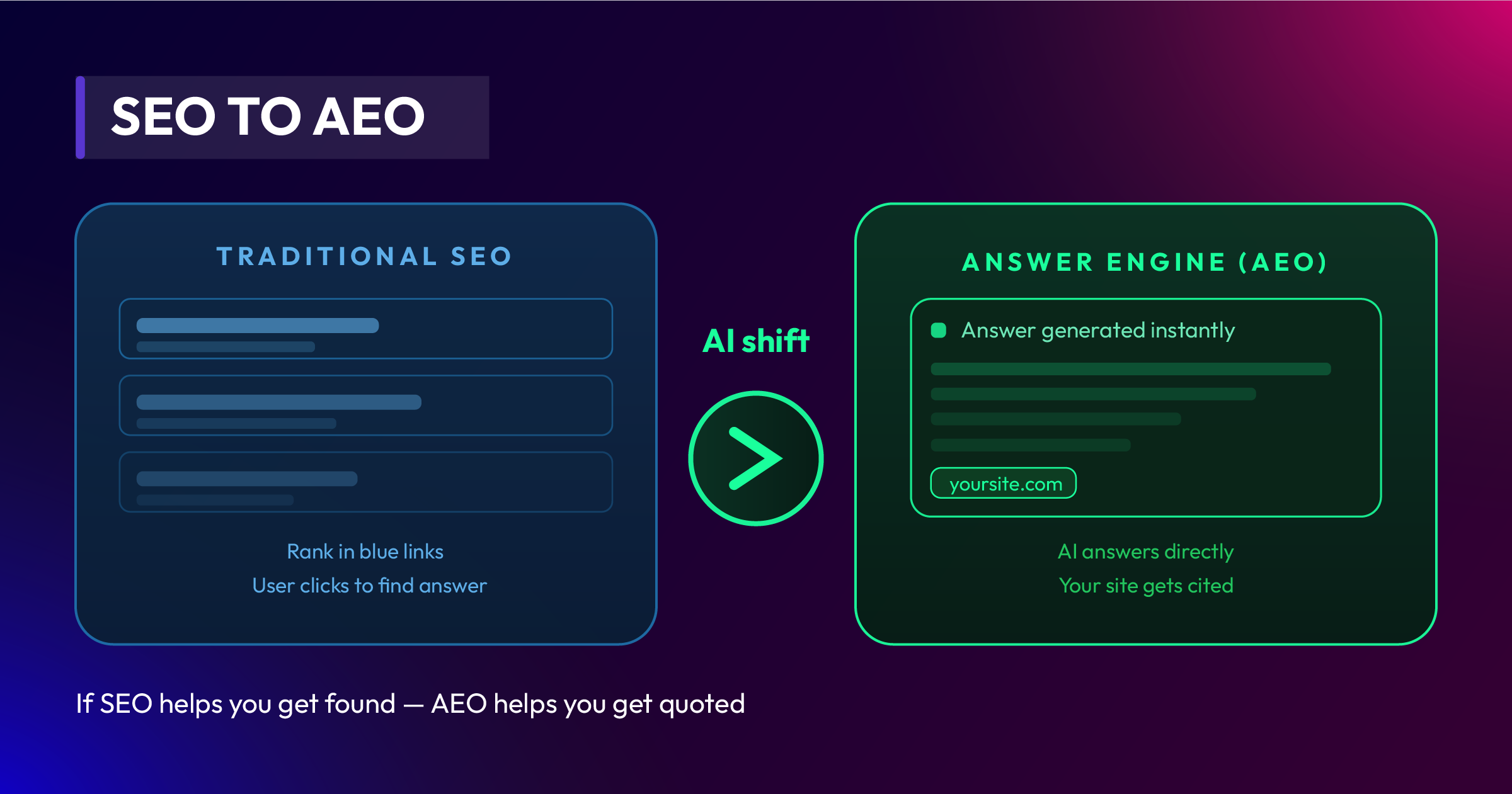
While traditional SEO is about climbing the ranks in the search results, AEO is about being the source an AI turns to when delivering those results, often without the user ever clicking a link.
Let’s break down the core differences:
1. Query Intent
- SEO targets keyword phrases, often transactional or navigational.
- AEO focuses on natural, question-based queries like “What is AEO?” or “How does ChatGPT choose sources?”
Users are seeking immediate answers, not necessarily full pages.
2. Format and Structure
- SEO content can span long-form blogs with intros, transitions, and broad coverage.
- AEO content thrives on tight formatting: bulleted lists, short paragraphs, and direct answers under headings.
AI models like GPT-4 and Google AI Overviews rely on clear patterns to extract meaning. If your content isn’t structured logically, it won’t get picked up.
3. Delivery Platforms
- SEO is about ranking on Google’s SERPs.
- AEO targets platforms that synthesize and summarize, like Google AI Overviews, ChatGPT, or Perplexity.ai.
In short: if SEO helps you get found, AEO helps you get quoted. It’s the next logical evolution in making content discoverable and usable in an AI-first world.
Why AEO Matters Now
We’re witnessing a quiet revolution in how people find information. Traditional search is still here, but it’s no longer the only player. AI-powered answers are reshaping expectations, behaviors, and even what it means to be “discoverable” online.
1. The Rise of Zero-Click Search
More than half of all Google searches now end without a single click. This phenomenon, known as zero-click search, is the direct result of users getting their answers right there, in snippets, panels, or now, generative summaries (AI Overviews).
2. AI-Generated Answers Are Becoming the Norm
Tools like ChatGPT, Bing Copilot, and You.com aren’t just search engines. They’re answer engines — designed to synthesize, summarize, and cite content in real-time. Users don’t care where the information comes from; they just want it to be fast, accurate, and easy to digest.
3. Shifting User Expectations
In the AI era, people expect:
- Immediate answers (not long articles)
- Clear explanations without fluff
- Trustworthy sources and citation
That means your content needs to be answer-ready from the start.
Key Stats That Tell the Story
This shift isn’t theoretical — it’s measurable. And it’s already happening.
| Trend | Stat |
|---|---|
| Zero-click searches | Over 58% of Google searches end with no click (SparkToro) |
| Chat-based search growth | 400M+ weekly active users on ChatGPT as of 2025 (Exploding Topics) |
| Organic CTR decline due to AI Overviews | Desktop CTR falls from about 13% to less than 5% Mobile CTR drops from about 20% to 7% (Search Engine Land) |
| AI-powered platforms adoption | Perplexity.ai traffic surged to 57M+ monthly visits in 2024 (Demandsage) |
How Answer Engines Work
Answer engines may seem like magic, but under the hood, they’re powered by very real tech — specifically, large language models (LLMs) and a process called retrieval-augmented generation (RAG).

What’s an LLM?
A large language model, like OpenAI’s GPT-4 or Google’s Gemini, is trained on massive amounts of text to learn how humans write and speak. These models can generate eerily accurate responses to questions, complete sentences, and even mimic tone.
But here’s the catch: they don’t actually understand the content — they just predict what words are likely to come next. That’s why context, clarity, and source material matter so much.
What is RAG: Smarter, Safer Answers
To make LLMs more reliable, platforms like ChatGPT with browsing and Perplexity.ai use retrieval-augmented generation. This means that before giving an answer, the model searches real-time sources — web pages, databases, or trusted documents — and uses that information to respond.
It’s like doing homework before answering a question.
How the Engines Generate Answers
Let’s break it down:
- Google’s AI Overviews scans the web and Google’s knowledge graph to generate instant summaries directly in search results.
- ChatGPT (with browsing) searches live sites and cites its sources at the bottom of the response.
- ai takes it further, pulling from multiple high-authority sources and linking them inline.
These platforms are designed to find clear, well-structured, trustworthy content, then rephrase or summarize it. That means if your content isn’t scannable or well-organized, it’s unlikely to be selected.
Why Data Sources Matter
AI tools don’t guess. They cite. If your website is well-optimized, accurate, and easy to parse, it has a much higher chance of being pulled into an answer.
Want to be quoted? Write like you’re solving a problem, not selling one.
AEO vs. SEO: Key Differences in Strategy
At first glance, SEO and AEO might look like two sides of the same coin. After all, both aim to get your content found online. But dig a little deeper, and you’ll see they’re built on very different foundations.
Let’s break down the core differences in a side-by-side format:
| Element | SEO | AEO |
|---|---|---|
| Primary Goal | Rank on search engine results pages (SERPs) | Be cited or summarized by AI-powered answer engines |
| Intent Targeting | Keywords and keyword clusters | Questions and natural language phrasing |
| Content Structure | Long-form, keyword-rich, hierarchical | Clear answers, logical flow, concise formatting |
| Delivery Platforms | Google, Bing, traditional search | Google AI Overviews, ChatGPT, Perplexity, You.com |
| Success Metrics | Rankings, clicks, dwell time | Citations, inclusion in answers, source attribution |
| Content Length | In-depth Pages | Concise, Contextual Answers |
| User Experience | Human reader journey through full page | AI summarization and quick answer extraction |
Answer engines don’t “browse” like humans do. They look for structured, scannable, and intent-matching content that they can trust. That means traditional SEO tactics like keyword density or backlink building aren’t enough on their own.
AEO requires you to think like an answer engine:
- What question is the user really asking?
- Can this be understood and quoted by a machine?
- Is the answer up front, or buried in a sea of fluff?
If SEO is writing for searchers, AEO is writing for search engines that answer. The best content today does both.
Core Elements of an AEO Strategy
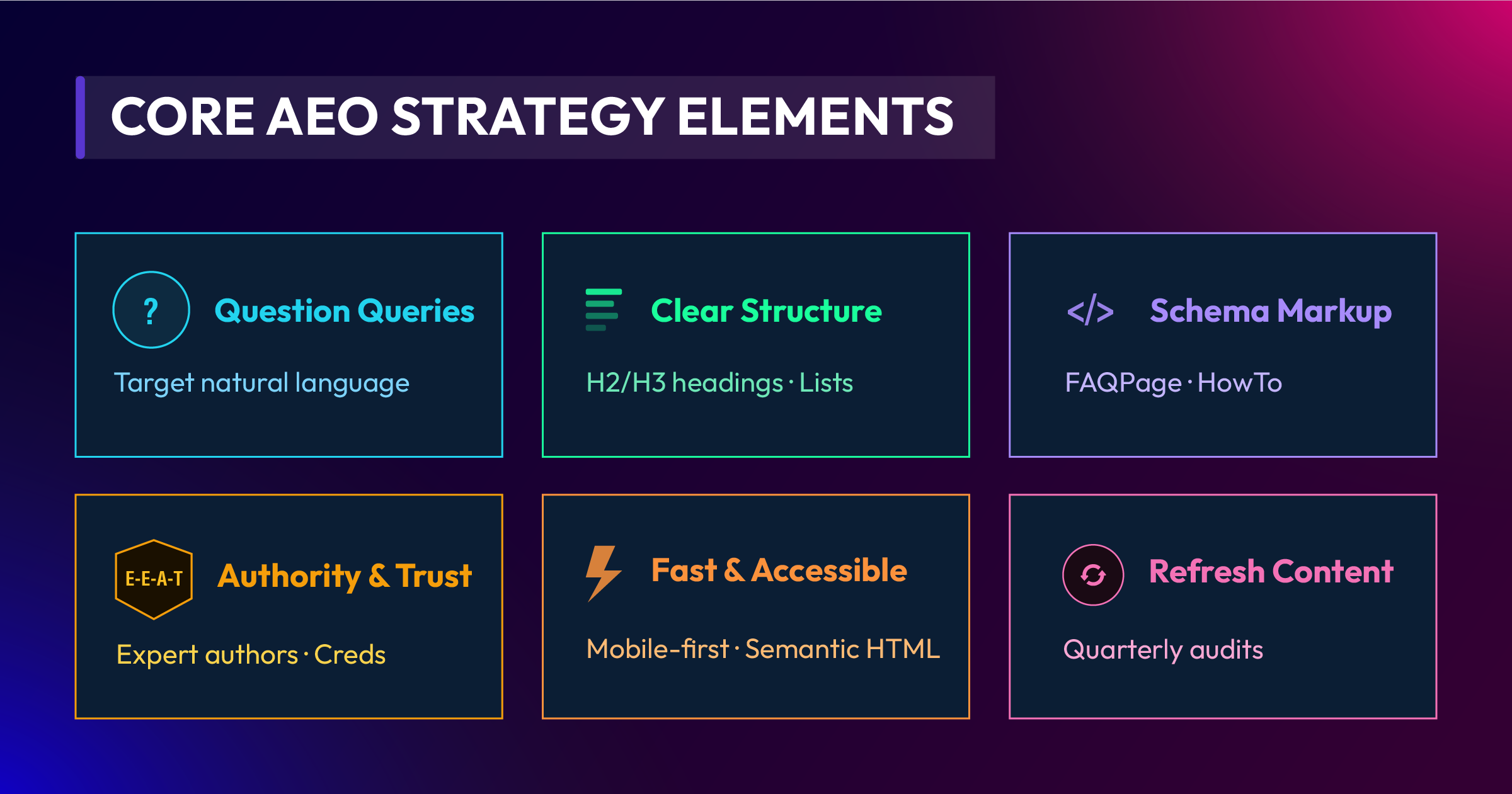
Optimizing for answer engines isn’t just about reformatting your blog posts — it’s about rethinking how information is delivered, consumed, and reused by machines trained to mimic human reasoning.
Here’s how to make your content answer-ready.
1. Understand and Target Question-Based Queries
Search engines may love keywords, but answer engines love questions. AEO starts with identifying what your audience is really asking — and how they’re asking it.
Use these tools to uncover common and emerging questions:
- AlsoAsked visualizes follow-up questions and query trees based on Google’s People Also Ask boxes.
- AnswerThePublic aggregates autocomplete data from Google and Bing to show how users phrase queries.
- Semrush’s Question Filter helps isolate question-based keywords from broader research.
Don’t stop there. Forums like Reddit and Quora reveal how people naturally express confusion, curiosity, or frustration. These exact phrasings are gold when you’re writing for AI to latch onto.
2. Structure Content for Clarity
If your content is disorganized or buried under fluff, answer engines will skip right over it.
Here’s how to keep it clean:
- Use H2s and H3s that closely match question phrasing.
- Begin each section with the most direct answer possible.
- Keep each paragraph to 3-4 lines max — brevity helps machines extract meaning faster.
- Include bullet points, tables, or numbered lists to present steps or options.
- Use summaries or TL;DRs at the end of sections when possible.
The goal is to eliminate cognitive load for both humans and AI.
3. Use Schema Markup Strategically
Structured data isn’t just for technical SEO anymore — it’s a core part of making your content answerable.
Here are schema types worth using:
- FAQPage – for multi-question formats.
- HowTo – perfect for step-by-step instructions.
- QAPage – useful when structuring community-driven or forum-style content.
- Article – helps AI engines understand blog structure and author information.
Try tools like Schema.dev or Google’s Markup Helper to simplify implementation.
4. Prioritize Authoritativeness and Source Trust
AI models look for trustworthy, expert-level content. Even though they don’t “believe” anything, they’ve been trained to favor pages that demonstrate E-E-A-T: Experience, Expertise, Authoritativeness, and Trustworthiness.
- Publish under real authors with bios and credentials.
- Reference credible studies, whitepapers, or .edu/.gov sites.
- Aim to earn backlinks from respected sources in your field.
Platforms like Perplexity.ai and ChatGPT’s browsing model lean heavily on citation-worthiness. Being trustworthy isn’t optional; it’s foundational.
5. Keep Pages Lightweight and Accessible
User experience affects AEO. The faster and more accessible your site, the better it performs for users and AI engines alike.
- Compress images and limit unnecessary scripts for fast load speeds.
- Design pages for mobile-first consumption.
- Use semantic HTML and ensure ADA compliance — not just for users with disabilities, but for AI parsing accuracy.
Accessibility enhances machine readability, which in turn improves your chances of being selected as a credible source.
6. Refresh and Revalidate Content Frequently
Search engines love fresh content. So do answer engines. AI platforms tend to pull from the most recent, reliable answers available.
Best practices:
- Review top-performing pages quarterly to ensure accuracy.
- Use Ahrefs Content Audit or SurferSEO’s audit tool to identify outdated or underperforming content.
- Update headlines, stats, internal links, and formatting.
- Add new FAQs, summaries, or diagrams where relevant.
Content that stays current stays visible — and answerable.
💡 For a more in-depth approach to optimizing content for AI-driven platforms, check out our detailed guide on Generative Engine Optimization (GEO).

Optimizing for Specific Answer Engines
Not all answer engines work the same way. Here’s how to align your content with the expectations of Google AI Overviews, ChatGPT with browsing, and Perplexity.ai.
| Answer Engine | How It Works | Optimization Tips |
|---|---|---|
| Google AI Overviews | Summarizes answers in the search results using a mix of web content, the Knowledge Graph, and current search context. Citations are rare or indirect. | – Use FAQPage, HowTo, QAPage schema – Write concise, factual answers under clear H2s – Limit fluff and opinionated language – Include sourced facts, definitions, or structured lists |
| ChatGPT (with browsing) | Browses the live web to pull relevant content. Cites sources at the bottom of responses. Available in ChatGPT Plus and Enterprise. | – Make sure your content is crawlable and uses HTTPS – Front-load answers in the first 1–2 paragraphs – Use bullet points and tables – Avoid intrusive elements like popups or interstitials |
| Perplexity.ai | Acts as a conversational search engine that cites sources inline and links back to referenced pages directly. | – Focus on fact-based, direct language – Structure with semantic HTML for easy parsing – Include citations or references in your own content – Publish under trusted authors or brands |
The Role of Topical Authority in AEO
In the context of Answer Engine Optimization (AEO), topical authority is extremely important. AI models don’t rank pages; they infer trust. And they’re more likely to pull answers from sites that have clearly demonstrated deep, consistent expertise in a subject.
What Is Topical Authority?
Topical authority means your site is seen as a go-to source for a particular subject area. You’re not just writing one article about a topic — you’re building a library of related, well-structured, trustworthy content that thoroughly answers all angles of the conversation.
For example, if your site covers “local SEO,” you shouldn’t stop at a single blog post. You should cover:
- What is local SEO?
- How to optimize Google Business Profiles
- Local citation strategies
- Technical SEO for location pages
- Local SEO trends in 2025
This cluster of interlinked content signals to both users and answer engines that your site is a serious authority.
Why Topical Authority Affects AI Visibility
AI engines like ChatGPT and Perplexity.ai draw from a wide range of sources, but they prioritize those that demonstrate trust and relevance.
Sites with deep topical coverage are:
- More likely to be cited across multiple queries
- Seen as higher-quality sources by retrieval models
- Better structured for clear, contextual answers
Building topical authority also increases your odds of showing up in Google’s AI Overviews, where multiple related pages from the same site may influence the summary.
Tip: Think beyond keywords. Think in content clusters — each piece supporting a broader subject area. That’s how you future-proof your site in the age of answer engines.
Tracking AEO Success: KPIs to Watch
Measuring traditional SEO is straightforward — rankings, organic traffic, clicks. But Answer Engine Optimization (AEO) requires a different lens.
Since answer engines often summarize or cite content without sending traffic your way, you need to track visibility, authority, and influence rather than just volume.

1. Mentions and Citations in AI Tools
While Google AI Overviews rarely link directly, tools like Perplexity.ai and ChatGPT show citations. Search your domain name or blog post title in these platforms periodically to see if you’re being referenced.
There’s no official dashboard (yet), but keeping a record of these citations helps measure how “answerable” your content is.
2. Direct Traffic from AI Sources
Even though some engines don’t drive high click-through, others like Perplexity do.
Look in Google Analytics for:
- Referral traffic from tools like ai, you.com, or gemini.google.com
- Sudden spikes in traffic to evergreen content — this may signal AI exposure
3. Engagement Metrics
If users are finding your page through AI answers and clicking through, their behavior matters:
- Time on page
- Bounce rate
- Scroll depth
These signals indicate whether the visitor found what they were looking for.
4. Content Coverage Health
Use tools like SurferSEO or Ahrefs to track:
- Topical coverage (do you fully address your niche?)
- Content decay (has older content lost relevance?)
Remember: in AEO, traffic is a byproduct — not the goal. Visibility, citations, and influence are your new benchmarks.
How ShiftWeb Implements AEO for You
AEO is one part of a larger shift we call Generative Engine Optimization (GEO). AEO focuses on making your content answer-ready for tools like Google’s AI Overviews and Perplexity.
GEO expands on that by addressing the full range of AI-driven discovery — content, structure, reputation, and reach.
That’s why our GEO service is built specifically to help your business become the answer AI recommends across platforms like Google’s AI Overviews and ChatGPT.
We go beyond traditional SEO to help you craft content that machines understand, trust, and pull from.
What We Do
At ShiftWeb, we don’t just optimize for algorithms — we optimize for how AI thinks.
Our done-for-you GEO service focuses on:
- Reworking your main landing page so it’s structured, scannable, and semantically aligned with how real people search — and how AI understands intent.
- Implementing schema markup to help engines interpret your content at a deeper level.
- Building high-authority backlinks to reinforce credibility across the web.
- Publishing a press release on 700+ outlets to inject your brand into the wider digital ecosystem.
- Creating an optimized listicle blog that positions you as the top solution in your niche — ideal for AI extraction.
GEO or AEO doesn’t replace SEO — it builds on it. We make sure your technical foundation is solid, then optimize for the new reality: AI search.
By aligning your site with AI-friendly structure, language, and reputation cues, we increase your odds of being cited, summarized, and chosen.
Want to be visible in AI-driven search? Request a Free Site Review and let’s put your business in front of the tools people actually use.
Future of AEO: What’s Next?
Answer Engine Optimization isn’t a temporary trend — it’s the groundwork for how users will interact with information moving forward. As AI tools become more sophisticated, the rules of digital visibility will continue to evolve.
Here’s what’s on the horizon:
| Trend | What It Means | Why It Matters |
|---|---|---|
| Branded Experiences in AI Search | AI tools will start showcasing businesses with consistent voice, value clarity, and trusted content, not just surface-level answers. | Businesses that invest in brand consistency and authority now will gain a competitive edge in AI-generated responses. |
| Voice, Visual, and Multimodal Search | AI-powered tools are moving beyond text to include voice (spoken answers), images, and context-aware prompts (e.g., GPT-4o and Google Lens). | Your content must be accessible, structured, and semantically rich across media types, not just words. |
| Personal Assistants & AI Interfaces | AI assistants like ChatGPT, Gemini, and Siri are replacing traditional browsing for many users. | Businesses not optimized for these interfaces risk being invisible to users who never visit a search engine. |
Why Small Businesses Must Act Early
Larger brands can afford to be late adopters. Small businesses can’t.
The earlier you build a strong, AI-friendly digital presence, the easier it is to:
- Be cited by AI engines now
- Build domain and topical authority before competitors
- Adapt quickly as the landscape shifts again
Waiting means losing ground to businesses that are already speaking AI’s language.
Your Next Steps: Adapt Now to Future-Proof Your Visibility
Bottom line: The search landscape is no longer keyword-first — it’s context-first. And context is shaped by structure, clarity, and trust.
Search isn’t just surfacing links anymore. It’s generating answers, shaping opinions, and deciding what gets seen. That means if your business isn’t structured to be understood and trusted by AI tools like Google’s AI Overviews and ChatGPT, you’re already behind.
Answer Engine Optimization (AEO) — and by extension, Generative Engine Optimization (GEO) — is no longer optional. It’s the foundation for digital visibility in an AI-dominated future.
You don’t need more content. You need better content shaped for how AI finds, interprets, and selects information. And you need to start now, while the competition is still catching up.
Need help to make your business the brand that AI recommends — clearly, confidently, and consistently? Request a free GEO audit and let’s build your AI-first visibility strategy today!


