

If you’ve ever spent months creating content that barely moved the needle, you’re not alone.
Most content strategies today feel like a shot in the dark because they rely on instincts and outdated keyword lists. You publish blog after blog, chasing keywords, hoping something ranks—and usually, it doesn’t.
Posts go live in isolation. There’s no structure. No long-term plan. And more than 90% of that content? It never ranks. Never gets traffic. Never gets read.
That’s the problem Pillar-Based Marketing (PBM) is built to solve.
PBM gives you a clear, data-driven way to create content that works together—strategically structured around how people search, what they actually ask, and how modern AI systems choose what to feature.
The result? A content system that ranks faster, earns visibility, trust, and momentum across your entire niche.
This guide breaks it all down. You’ll learn why PBM is different from traditional SEO, how it works, and how to build your own PBM system from the ground up with step-by-step instructions.
What’s Wrong with Traditional SEO and Content Marketing

The Guesswork Epidemic—Most Content Never Performs
Let’s start with a number that should make your stomach drop: 90.63% of all web content gets zero traffic. Not “low” traffic—none. And only 1–4% of blog posts drive any meaningful results. That means the vast majority of content is essentially invisible—despite the time, energy, and budget invested in it.
It’s the clearest sign that most content marketing strategies aren’t working. And deep down, most marketers know it.
They spend months writing blog posts, optimizing pages, and hoping something sticks. They launch campaigns with keyword tools and intuition, then wait six to twelve months to maybe, possibly see results.
In the meantime? Anxiety. Missed goals. Lost clients.
The problem isn’t a lack of effort or skill. The problem is guesswork—strategies built on gut feelings and keyword spreadsheets rather than real behavioral data.
As Ryan Brock and Christopher Day, the authors of the PBM methodology, put it in their book, this kind of work lives in the “land of waste and anxiety.”
Why “Random Acts of Content” Fail
We’ve all seen the classic blog strategy: publish a post every week on different “relevant” topics and cross fingers. But this scattershot approach doesn’t build momentum.
Even well-meaning marketers fall into the trap of publishing content in isolation. You write a post, hit publish, share it around — then move on to the next one. There’s no larger structure. No compounding effect. No strategy behind why this piece of content exists.
This “random acts of content” problem stems from a broken editorial process.
The Broken Editorial Calendar
Most teams operate on editorial calendars that plan content based on brainstorms or general “themes of the month.” These calendars are rarely backed by search behavior data, and almost never mapped to a pillar structure.
So what happens?
- You create posts without context — and they don’t connect to anything else on your site.
- Readers (and search engines) can’t understand the bigger picture.
- Internal linking is forgotten or forced.
- You lose the chance to build true topical authority.
This is why most editorial calendars don’t work. They become a graveyard of isolated efforts instead of a roadmap to page one.
Here’s why traditional content plans fail:
- No topic hierarchy → Google doesn’t see you as an authority.
- No alignment with real queries → Users don’t find you when they search.
- No continuity → AI engines like Google’s MUM can’t connect the dots.
This is a result of failure of internal focus: marketers obsess over what they want to say, not what customers are asking. The result? Content that feels disconnected, unhelpful, and invisible in search.
What This Means for You
If your current strategy looks like:
- Keyword list → blog post → publish → repeat
- A few “pillar pages” disconnected from everything else
- Monthly posts chosen by gut feel or internal agendas
Then it’s not a strategy; it’s a guessing game.
It’s time to switch to pillar-based marketing, which offers a better way: one that removes the guesswork and replaces it with structure, behavior-driven mapping, and predictable results.
Why This Matters More Than Ever
Today’s search engines—and AI assistants like ChatGPT or Perplexity—don’t want shallow content. They want networks of information. Posts that connect, reinforce, and prove you’re an expert across a whole topic.
This is why disconnected posts, even when well-written, fail. They don’t signal authority. They don’t answer real, evolving questions. And they don’t earn trust from users or AI systems.
The truth is, most marketers aren’t failing because they’re bad at their jobs. They’re failing because the old tools—random blogs, keyword lists, isolated pages—were never designed for how people search or how AI now ranks.
PBM fixes this by replacing guesswork with a structured, behavioral-data-driven strategy.
The Page One Imperative—Traditional SEO Rarely Gets You There
Here’s the brutal math: 90%+ of all search traffic goes to page one of Google, with the top three results getting the lion’s share.
If your content doesn’t show up there, it might as well not exist. Page one is where qualified traffic, AI summarizers, and real business outcomes live. Everything else is the long tail of lost opportunity.
That means the difference between a successful piece of content and one that flops isn’t how “well-written” it is—it’s whether it’s strategically positioned to earn trust, authority, and visibility.
Traditional SEO tactics don’t solve this. Writing more content doesn’t solve this. You need structure, intent-matching, and a content system designed to rank across full buyer journeys. That’s what PBM delivers.
What Is Pillar-Based Marketing, Really?
Pillar-based marketing (PBM) is a modern content strategy designed to build compounding topical authority. At its core, PBM starts with a pillar topic—a broad, high-value concept you want your brand to dominate.
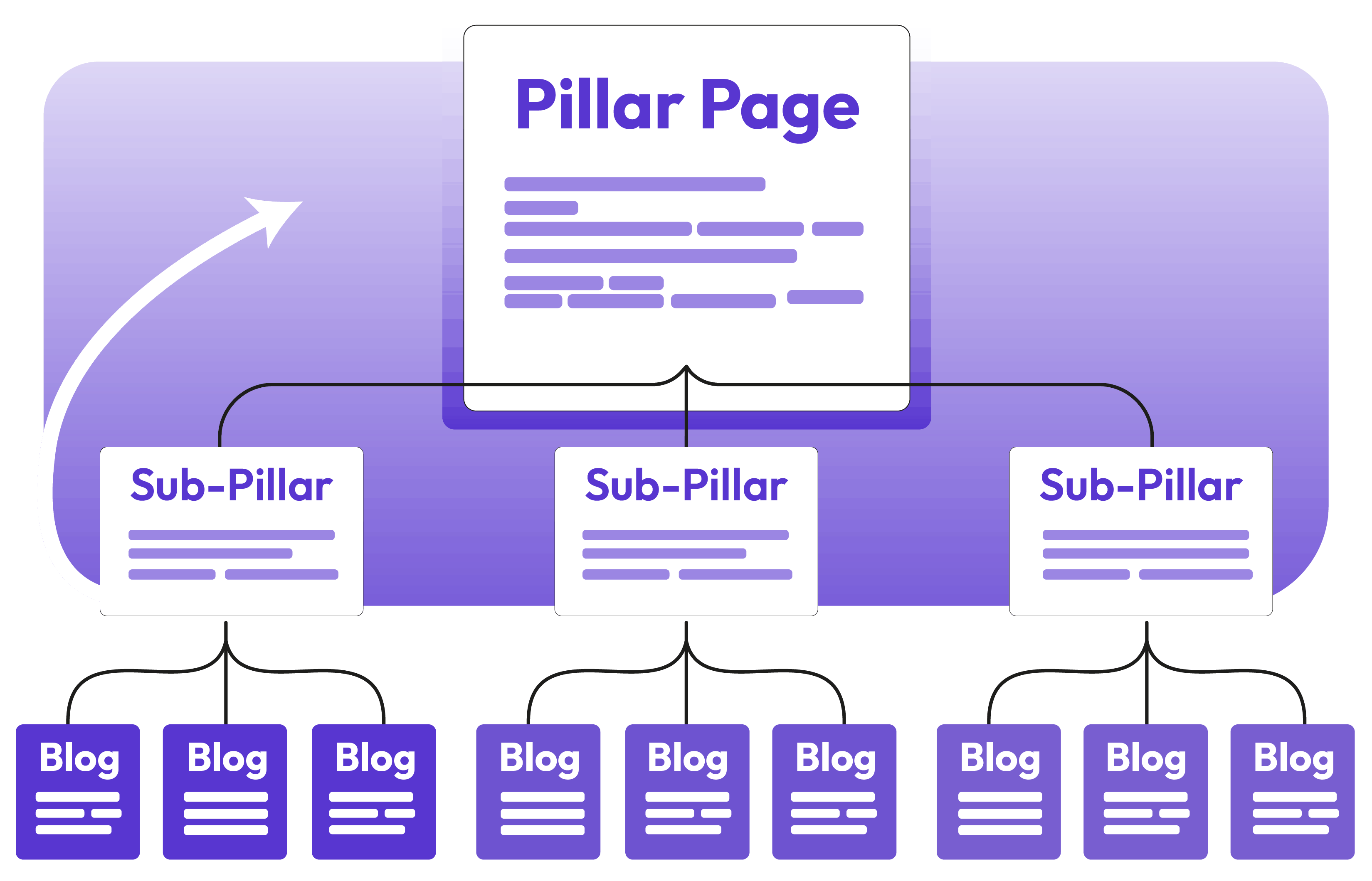
From there, you create a structured network of sub-pillars (mid-level topics) and supporting blogs (hyper-specific long-tail content), all interlinked to serve real search behaviors.
- Sub-Pillars: Medium-depth pages covering narrower slices of the main topic
- Supporting Blogs: Short, focused posts that address ultra-specific questions
This creates an entire content ecosystem that flips the usual SEO playbook. Instead of chasing one-off keyword wins, PBM builds an intentional content hierarchy that mirrors how your audience actually searches—not how keyword tools guess they do.
It’s not about posting more. It’s about posting with purpose, based on patterns of human behavior.
PBM answers:
- What do people ask first?
- What do they ask next?
- And how can we meet them with the right content at every turn?
PBM ≠ Generic Topic Clusters
Many SEO agencies talk about “topic clusters,” but what they really mean is:
- Grouping a few keywords under a general topic
- Linking posts back to a main page
That approach is tactical at best—and disconnected from the way people search today.
PBM, by contrast, maps out actual behavioral networks. It’s not just based on what people search for, but how they actually move through topics, how their questions evolve, and how their intent deepens.
This includes:
- Query clustering (grouping related queries based on intent)
- Search path modeling (mapping how users navigate from question to question and what they click before and after)
- Demand mapping (which questions are rising or declining)
This behavioral spiderweb pattern of a searcher’s journey is the blueprint behind every content decision in PBM. We’ll learn about this in greater detail later in the blog.
So while topic clusters might give you a bucket of loosely connected content, PBM gives you a strategic, data-backed publishing plan—one that builds topical authority and fuels visibility across hundreds of search terms.
In other words, it helps you publish content in the order people discover it, not the order your calendar says.
The Hub-and-Spoke Model (But More Nuanced)
Think of your pillar page as the center of a wheel. Every sub-topic you write is a spoke leading back to that hub, reinforcing your expertise.
PBM builds on this idea, but with more depth and flexibility.
- Your Pillar Page sits at the center covering the main topic.
(e.g., “content marketing”) - Around it, you publish Sub-Pillar Pages, breaking down related areas.
For example, if your pillar is “content marketing,” sub-pillars might include “content marketing strategy,” “types of content marketing,” or “B2B content marketing.”
Then comes the long tail:
- Supporting Blogs answering extremely specific questions like “What’s a good ROI for content marketing?” or “How much should I pay for a content marketing agency?”
This is how PBM creates an interconnected spiderweb, not a loose cluster.
Unlike random isolated blog posts, each of these layers is designed to target a slice of the customer journey — and when they’re all linked together intentionally, they signal to both humans and AI that your brand owns this space.
This creates layers of authority, trust, and discoverability — all working in unison.
Funnels Are Outdated—The Spiderweb Model is How People Actually Buy
Funnels Are Too Linear for Today’s Buyer
The traditional marketing funnel paints a neat, tidy picture: someone finds your brand, considers your product, then decides to buy.
For years, marketers have relied on this neat, staged metaphor where buyers move smoothly from awareness to interest, desire, and action.
But here’s the truth: real users don’t move in straight lines when making a purchase. They jump, bounce, search, compare, validate, and repeat. According to Pillar-Based Marketing, this assumption of linearity is outdated and leads to serious strategic blind spots.
Think about your last major purchase — did you move smoothly down a funnel? Or did you open five tabs, bounce between articles, revisit questions, and double-check vendors?
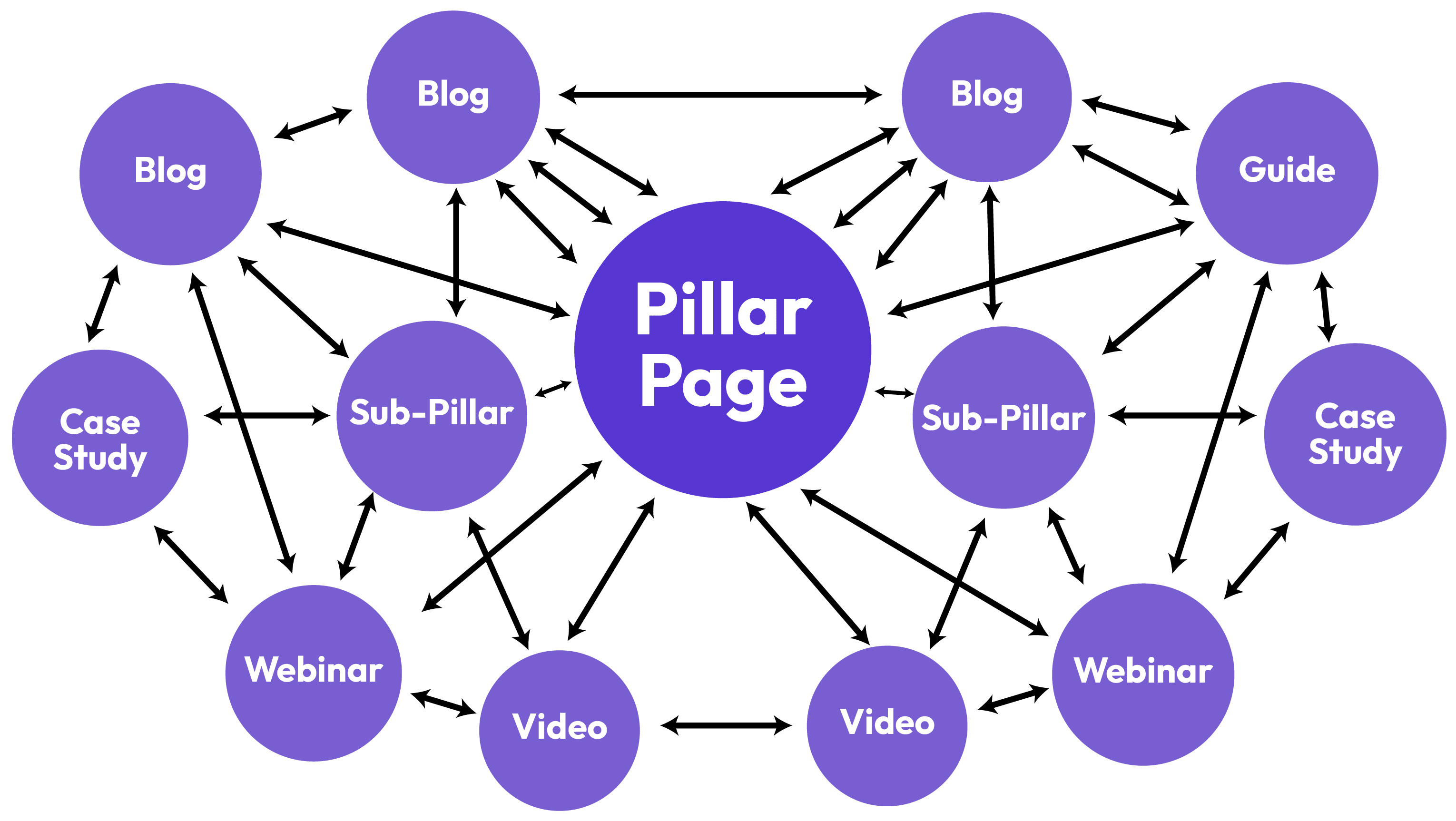
That’s the real behavior PBM is built to serve. It replaces the funnel with something more true to life to represent this nonlinear reality: the Spiderweb Model.
Spiderwebs—The Foundational PBM Mindset
Pillar-based marketing asks you to stop thinking linearly and start thinking like a spider weaving a web.
The Spiderweb Model isn’t just a metaphor; it’s a visual and strategic framework that reflects how buyers actually research. It accounts for:
- Search diversity—the range of related questions a person might ask
- Search frequency—how often certain questions appear
- Topical proximity—how close each question is to the core buying intent
- Behavioral connections—the way questions link and build on each other
PBM maps this web of connected searches and turns it into a content hierarchy: starting from your central pillar topic and stretching out into sub-pillars and long-tail supporting blogs.
And it’s not theoretical. In the book Pillar-Based Marketing, Brock and Day explain that this model emerged from years of hands-on SEO experience—watching which pages users visited, what they clicked next, and what kept them moving.
Over time, a shape appeared: not a line, but a network.
That shape is your Spiderweb—and it’s the blueprint for your publishing plan.
The Six Buying Jobs by Gartner
The PBM spiderweb model is powered by a buyer psychology framework from Gartner, breaking down six buying ‘jobs’. These jobs are the steps buyers must complete before making a purchase.
And critically, these jobs don’t occur in order. Buyers loop back and revisit earlier stages constantly. A cornerstone of the PBM approach is aligning your content with these tasks.
Here are the six jobs, and what they mean for your content:
- Problem Identification
The buyer realizes there’s an issue. You need content that helps name and articulate that problem. - Solution Exploration
They start looking at possible fixes. Think guides, overviews, and comparisons that broaden their perspective. - Requirements Building
Now they’re defining what a solution must have. Your job? Supply detailed, trust-building content about features, pricing, integrations, etc. - Supplier Selection
They’re choosing who to buy from. This is where case studies, differentiators, and expertise come in. - Validation
Stakeholders want reassurance. You need third-party proof, social evidence, and credibility here. - Consensus Creation
Everyone must agree. Create content that arms your internal champions with the info they need to sell your solution inside their company.
Most SEO strategies only try to rank for “solution exploration” or “supplier selection” terms—the classic “money keywords.” PBM flips that. It builds a spiderweb of content that ensures you have a targeted, interconnected piece of content for every question at every stage of this journey.
Why PBM Works Better Than Traditional SEO (When Done Right)
1. Built on Real Search Behavior
Traditional SEO strategies often rely on keyword buckets or vague intent labels. PBM flips this on its head by grounding your strategy in behavioral network data—a map of what your audience is actually searching for, how often, and in what order.
That includes:
- Grouping real-world searches by meaning and intent
- Understanding how often questions are asked and how they connect
- Revealing the zig-zag journey people take from first query to decision
This data-driven map removes the guesswork and shows you exactly what to publish, in what order, and how to connect it.
2. Matches How People Actually Think & Search
Traditional marketing funnels assume a straight-line purchasing journey. But research, especially from Gartner, shows that buyers loop, backtrack, and repeat stages constantly.
Your content needs to serve all six jobs a buyer performs before making a buying decision, not just rank for one keyword. PBM helps you map out each layer of that journey so buyers encounter your content at every turn—regardless of where they start.
3. Aligns With AI-Driven Search
Pillar-based marketing is a fundamental part of AI SEO. Since PBM is built semantically and structurally, it’s inherently aligned with how AI interprets and summarizes content.
Large Language Models and AI-powered search overviews prioritize intent-matching, contextual relevance, and structured answers—all core outcomes of a well-built PBM system.
This means PBM content:
- Shows up in AI answers and overviews
- Gets better internal surfacing through search engines
- Matches multiple intents across queries
4. Compounding Results Over Time
Here’s the beauty of PBM: each new post doesn’t just stand alone—it strengthens everything around it. As your sub-pillars and supporting blogs grow, the topical authority of your pillar page grows with them. Rankings improve not only for individual articles, but across the entire cluster.
How to Build & Implement Your Own PBM Strategy: Step-By-Step Guide
Now that you know the what and why of pillar-based marketing, let’s get into the how.
This guide lays out exactly how you can come up with a real PBM strategy yourself, the right way.

Step 1: Choose Your First Pillar Topic
A strong pillar topic is not your internal product language. It is the most common point of interest that sits at the intersection of what your audience cares about.
Here are the most important things to consider when choosing your core topic:
Look for Intent Convergence
What topic do your ideal customers care deeply about? What questions do your customers consistently ask? What subject drives a ton of related questions, comparisons, and decision-making queries?
Think Like Your Buyer, Not Your Brand
Avoid internal bias and product-centric language. Instead, frame topics the way your market talks.
For example, instead of choosing something inward-facing like “our proprietary data processing platform,” a better pillar topic might be “data governance best practices.”
Why? Because it’s customer-centric. Prospective clients are searching for help with data governance, not your tool’s name.
So, when put together, here’s what your first to-do list looks like:
How to Pick Your Core Pillar:
- Write down 5-10 topics your customers already care about (problems, outcomes, comparisons, decisions).
- Cross out anything that is mostly internal jargon.
- Keep the topic that attracts the widest set of relevant questions, not just the highest-volume keyword.
- Shortlist 3-5 strong potential pillar topics based on frequency, business relevance, and alignment with buyer interest.
- Evaluate the shortlisted pillar topic candidates using the following checklist.
Mini Checklist to Compare Your Short List:
✅ Is this topic a recurring priority in your sales conversations?
✅ Does it appear across your ideal buyers’ customer journey?
✅ Does it match the language customers use (not your org chart)?
✅ Would a buyer research this before they ever talk to sales?
✅ Does it have subtopics and layers you could branch into?
✅ Can you imagine 30-100 real questions underneath it?
✅ Can you confidently own and speak to it in-depth?
✅ Could you credibly become “the” resource on it?
Once you’ve got a winner that checks all the boxes, plant your flag. That’s your core pillar topic, your long-term stake in the ground.
Step 2: Build a Spiderweb to Map the Behavioral Network
This is the core of PBM — building a map of how real people search and behave when making a purchase.
We call this map a spiderweb: a network of searches and questions buyers ask, and how they connect by frequency, connectivity, and distance from the core topic.
Important reality check: a complete spiderweb map is hard to do manually. (That’s why we offer help to do it for you completely)
Still, you can build a solid version yourself. Here’s how:
1. Collect Queries and Questions
Start by collecting every possible question related to your pillar:
- Explore Google SERP features deeply:
- Autocomplete
- People Also Ask
- Google Trends
- Related searches
- Competitor content
- Use SEO tools for keyword and query discovery, but don’t stop there.
- Pull headings from the top-ranking pages (table of contents, H2/H3s).
- Add comparison and validation angles:
- “best”
- “vs”
- “alternatives”
- “pricing”
- “reviews”
- “case study”
- “results”
- “examples”
- Add “next question” chains:
- For every question, ask: “If I got this answer, what would I search next?”
2. Mark Connections to Cluster the Queries
Once you have the set of queries, begin connecting them based on:
- What questions lead to follow-up questions
- Where comparisons show up
- What validation or trust-building queries appear
The goal is make it a web. To do so, draw a line between the queries when:
- One question naturally follows another
- “how” after “what”
- “cost” after “types”
- The SERP suggests a comparison
- “X vs Y”
- “X alternatives”
- Validation intent appears
- “does it work”
- “results”
- “is it worth it”
3. Tag Every Query Using the Gartner Buying Jobs Framework
As mentioned earlier, buyers loop, detour, compare, validate, and revisit across six tasks when buying something.
Link each query to one of these buying jobs:
- Problem identification: What is happening? Do we have a problem?
Query Example: “Why are my blogs not getting any traffic?”
🛈 Your content should help them realize there’s a problem worth solving.
e.g., “7 Reasons Why Your Blog Is Not Getting Any Traffic” - Solution exploration: What are our options to solve it?
Query Example: “What works better? Traditional SEO or pillar-based marketing?”
🛈 Your content should compare solutions without pushing one too hard.
e.g., “PBM vs Traditional SEO: Which is Better in 2026?” - Requirements building: What do we need from a solution?
Query Example: “What are the must-have features of an effective content strategy?”
🛈 Your content should make them consider what’s truly important before choosing a solution.
e.g., “14 Essential Elements Of A Strong Content Strategy” - Supplier selection: Who should we trust to help us?
Query Example: “How to choose the right marketing partner for my industry”
🛈 Your content should position your brand as the obvious solution without sounding salesy.
e.g., “Choosing the Right Marketing Partner: What to Look for in an SEO Agency?” - Validation: Will this actually work for us?
Query Example: “Does pillar-based marketing work for small businesses?”
🛈 Your content should show real outcomes and prove it’s not just theory.
e.g., “Case Study: How Pillar-Based Marketing Helped a Small Business Dominate Their Category in 30 Days” - Consensus creation: How do we get others on board?
Query Example: “How do I convince my boss to change the marketing strategy?”
🛈 Your content should arm your champion with everything they need to convince other stakeholders.
e.g., “How to Convince Your Boss to Modernize Your Marketing Strategy”
These are the real steps people go through—often looping back and repeating. If your spiderweb is missing a job, you are missing a chunk of demand (and usually missing the content that moves people forward)
Step 3: Turn the Spiderweb Into a Pillar Strategy
Now, you translate this map of buying behavior into a structure to create a content pyramid.
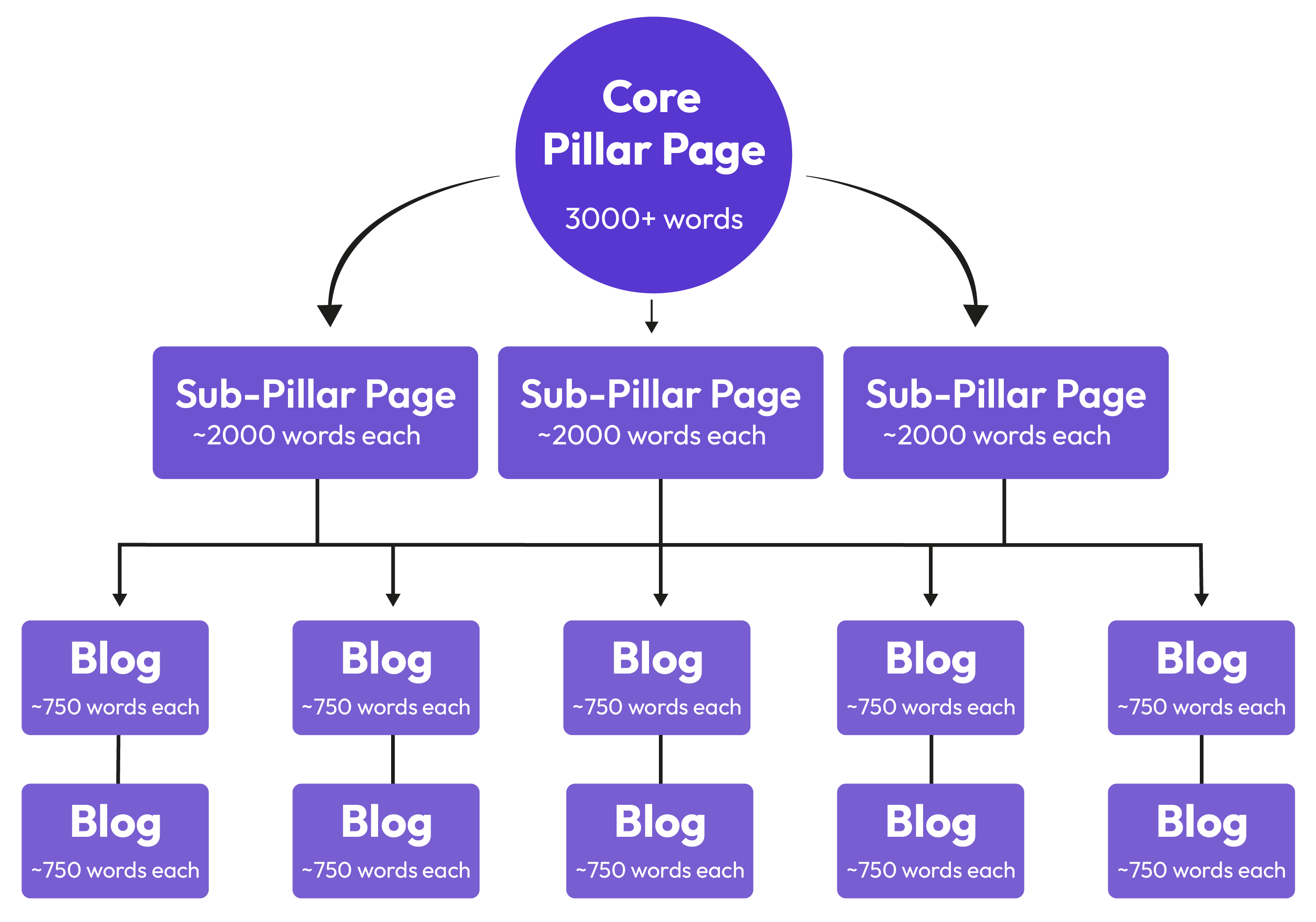
Pillar Page -> Sub-Pillar Pages -> Supporting Blogs
- Choose 3 Sub-Pillar branches that have high search volume and strong behavioral connectivity, i.e., the most central or connected clusters.
- Pick 3 Supporting Blogs for each sub-pillar (these should answer high-frequency, long-tail questions).
- Add 3 Supporting Blogs that link straight to the pillar to strengthen the hub.
Content Sizing Targets:
- 1 Core Pillar Page: 3000+ words
- 3 Sub-Pillar Pages: ~2000 words each
- 12 Supporting Blogs: ~750 words each
That’s 16 total pieces to build your first aggregate network, where each page reinforces the others through structure and internal linking.
You need to publish this network all in one go over the course of a few days, rather than one post per week. This signals to search engines that you are a credible authority on the core topic and not just someone who dabbles in it.
Step 4: Create the Content
Write each layer with a clear job:
1. Pillar page must:
- Define the entire topic clearly and comprehensively.
- Show the map (what you cover, what is linked out).
- Route readers into sub-pillars (so humans and systems see structure).
2. Sub-pillars must:
- Go deeper on a main branch.
- Route into supporting answers that complete that branch.
3. Supporting posts must:
- Answer one specific question cleanly in depth.
- Link upward so the hub gains authority.
Keep every piece:
- Structured (use clear headings, tables, bullets, FAQs)
- Semantic (match search intent, use natural language)
- Skimmable (short paragraphs, bolded key phrases)
- Credible (include sources, quotes, original insights, multimedia)
Keyword Guidance:
Here you have to put aside what you think you know about keywords and SEO, and build high-quality answers to real questions.
- Use the query language in titles and headings when it matches natural phrasing.
- Use synonyms and adjacent terms where they genuinely clarify meaning.
- Avoid forcing terms that make the sentence worse.
Your structure and completeness do more work than “perfect keyword density” ever will.
Internal Linking Rules:
Link upward so that:
- Every supporting post links up to its sub-pillar.
Supporting blogs → Sub-pillar - Every sub-pillar links up to the pillar.
Sub-pillar → Pillar
Step 5: Publish the Content
A critical PBM principle: don’t trickle out content — publish the whole 16-piece network at once within a course of a few days.
Why? Google and AI systems evaluate your topical authority as a whole. A full network signals coverage, coherence, and credibility.
That said, order still matters. You have to publish and index the pillar first, then the rest of the pieces of the pyramid top-down.
Before Publishing:
- Confirm all links are working
- Submit updated sitemap to Google Search Console
- Manually request indexing for your pillar + sub-pillars
- Ensure top-level navigation helps users discover the full cluster
Step 6: Measure What Actually Matters
Traditional reporting obsesses over individual posts. PBM tracks topic authority.
What to track:
- Topic-level movement (are you gaining visibility across the pillar, not just one URL).
- Performance by cluster (pillar, sub-pillars, supporting groups).
- Competitive benchmarking (are you taking share across the category, not just “ranking for one keyword”).
Real-World Results of PBM: Case Studies
One of the strongest arguments for pillar-based marketing is the results it delivers — not in vague terms, but in specific, measurable outcomes. Here are two clear examples of how organizations used PBM to rapidly transform their visibility and authority.
Case Study #1: 50x Increase in Keyword Rankings Within 14 Days
The Challenge:
Before PBM, this client struggled to gain traction in a competitive space dominated by long-standing legacy players. Their site had minimal visibility for industry-specific keywords and no content ranking on the first page.
The PBM Strategy:
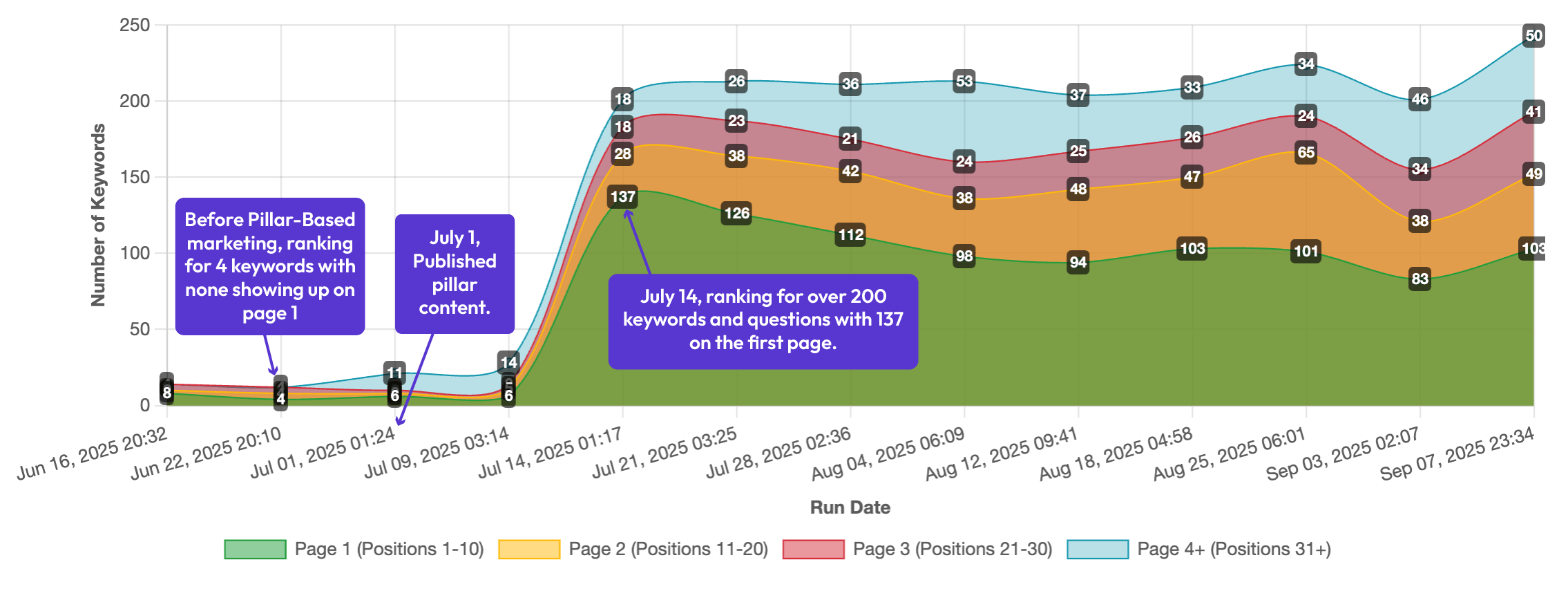
We built a comprehensive pillar strategy around the core topic and published the content on July 1, 2025.
The Result:
Within just 2 weeks of launch, the content started ranking for more than 100 unique keywords.
By week 4:
- Over 200 total keywords ranked
- 137 were ranking on page 1
- Multiple #1 rankings for high-converting questions
The client quickly became the go-to authority in their space, attracting architects, healthcare engineers, and procurement officers alike.
Case Study #2: 10x Increase in Keyword Rankings In Just 4 Weeks
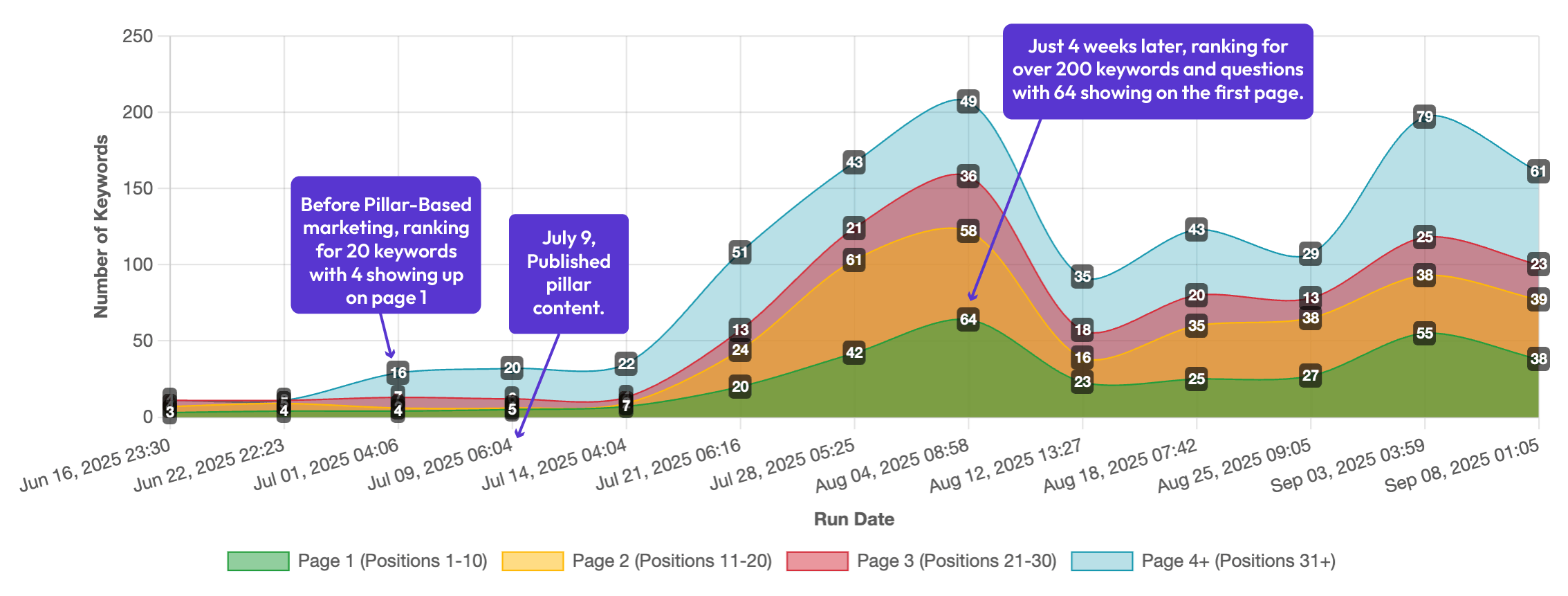
The Challenge:
This client operated in a small manufacturing niche with little organic authority and highly fragmented search demand. With traditional SEO, they were ranking for 20 keywords with only 4 showing up on page one.
The PBM Strategy:
Using the pillar-based marketing approach, we launched comprehensive content targeting the core topic on July 9, 2025.
The Result:
In just 4 weeks, their site experienced:
- A 10× increase in total keyword visibility
- Over 200 keywords ranked,
- More than 60 keywords ranking on page 1
With pillar-based marketing, the client pulled ahead as the authoritative voice in their segment.
Why Most “PBM” Services Fall Short
As shown above, PBM is really powerful—but only when done right.
A lot of agencies say they do PBM. In practice, most are doing upgraded keyword clustering and calling it a day.
They group terms, maybe build a rough topic list, and hand you a strategy doc. But they never map the real behavioral network: which questions connect, which paths buyers actually take, and which branches carry the most demand.
That is the difference between “content planning” and PBM.
Where most services fall short:
- They stop at keyword groupings. Useful, but PBM requires building your content around user behavior, not just keyword volume. Most teams don’t even attempt this.
- They do not model search paths. True PBM requires understanding how users move through their search journey—from first question to final action. When neglected, they cannot tell you what to publish first, what supports what, or how to keep your content ready when buyers loop through research.
- They lean on gut. Without data-driven planning—a real map of buyer demand, connections between queries—you’re just guessing. And guesswork doesn’t scale.
- They do not structure and execute it correctly. No clean pillar, no sub-pillars, no supporting layer, no intentional internal linking system. No hierarchy. No publishing order. Just a bunch of scattered posts that confuse both users and search engines.
PBM only works when the strategy and the buildout happen together: the network is planned, published, and linked as a coherent system.
Common PBM Mistakes to Avoid
Even with the best intentions, it’s easy to misapply pillar-based marketing if you skip the strategic groundwork. Let’s break down the most common pitfalls — and how to steer clear of them.
- Writing the Pillar First: It’s tempting to start with a big, shiny guide. But if you haven’t mapped the spiderweb first — the full network of questions and buyer intents — your pillar will likely miss the mark. Structure before content.
- Treating PBM as “Just One Long Page”: A 5,000-word article alone is not a pillar strategy. PBM works as a content network: the pillar, sub-pillars, and supporting posts working together.
- Publishing Disconnected Posts and Calling It a Cluster: Random blog posts with similar tags don’t make a cluster. Without a shared core, clear hierarchy, and strategic upward linking, you’re just adding noise. The pillar strategy has a structure that actually works.
- Choosing Pillar Topics Based on Internal Jargon: Don’t build around your product names or brand terms. That’s inside-out thinking. Instead, choose topics your audience already searches for—in their own words.
- Relying on Guesswork Instead of Actionable Data: PBM works only when it’s built on mapped search behavior—understanding how real search queries connect, in what order, and why—not on instinct or assumed keyword value.
- Relying on Funnels: People do not move linearly when buying—plan your strategies based on spiderwebs that reflect how people actually search.
What to Expect from a Strong PBM Program
When executed properly, pillar-based marketing (PBM) transforms the entire way your brand shows up in search, on AI tools, and in front of real buyers.
Here’s what you’ll notice:
Roadmap Clarity
With PBM, you’re no longer guessing what to publish. You have a clear map:
- Which topics to prioritize
- Which questions to answer
- Which content to publish first
This eliminates content paralysis. Everyone on your team knows the “why” behind each piece and how it fits into the larger spiderweb.
Faster Rankings
Because PBM aligns with real search behavior and search engine systems, results come faster. When the network is published together (not trickled out), you start seeing:
- Page 1 rankings in days or weeks
- High impressions for even low-authority sites
- Answers surfaced in featured snippets and AI summaries
AI Visibility
PBM content is structured for both humans and AI engines. That means:
- AI tools easily parse your pillar, sub-pillars, and supporting answers
- Semantic coverage helps you become the most complete answer
- Strategic Internal links form a strong, clear hierarchy for AI crawlers
This is what makes PBM AI SEO-ready by design.
Lead-Readiness
Your readers, who are actually buyers, land on your site and:
- See a complete picture of your expertise
- Find exactly what they need, no matter where they are in their search journey
- Trust your site enough to take the next step
The result? Increased time on site, engagement, and conversions. That’s what happens when your content actually helps people make decisions.

Want Help Doing This Right?
This guide gave you the roadmap to build a PBM strategy yourself—but if you want the fast track, we’ve got you.
At ShiftWeb, we don’t just talk about PBM—we do it. Fully. We combine a proven PBM methodology with proprietary tools and a done-for-you content engine to deliver real, measurable results.
Unlike typical SEO firms, we don’t hand you a strategy doc and wish you luck.
We handle it all — strategy, execution, and ongoing AI SEO support.
✅ You get behavioral data mapping
✅ A full content structure aligned to real search journeys
✅ Original content written, linked, and optimized to perform
Want a complete, hands-off pillar-based strategy implemented on your site? Request a Proposal
Frequently Asked Questions (FAQs)
- Is pillar-based marketing only for big sites?
Not at all. PBM works especially well for small and mid-sized sites looking to break into competitive niches. In fact, smaller teams benefit the most from having a focused, data-driven roadmap. - Do I need to write the content myself?
Nope. When you choose us for your PBM services, we handle the entire process: research, strategy, writing, linking, publishing—all done-for-you. You’ll approve the direction, and we’ll take it from there. - What if I already have a lot of content?
Great. We’ll audit your existing site, identify what fits into the PBM structure, repurpose what we can, and fill in the missing pieces. PBM works even better when built on solid existing assets. - How long does it take to see results?
We’ve seen page-one rankings in as little as 2 weeks, depending on competition and existing authority. Because PBM creates compounding topical strength, results tend to snowball—especially across full clusters, not just single pages.


